
The Passenger Syndrome: How to Stay a Developer in the Era of AI Without Losing Your Mind and Passion
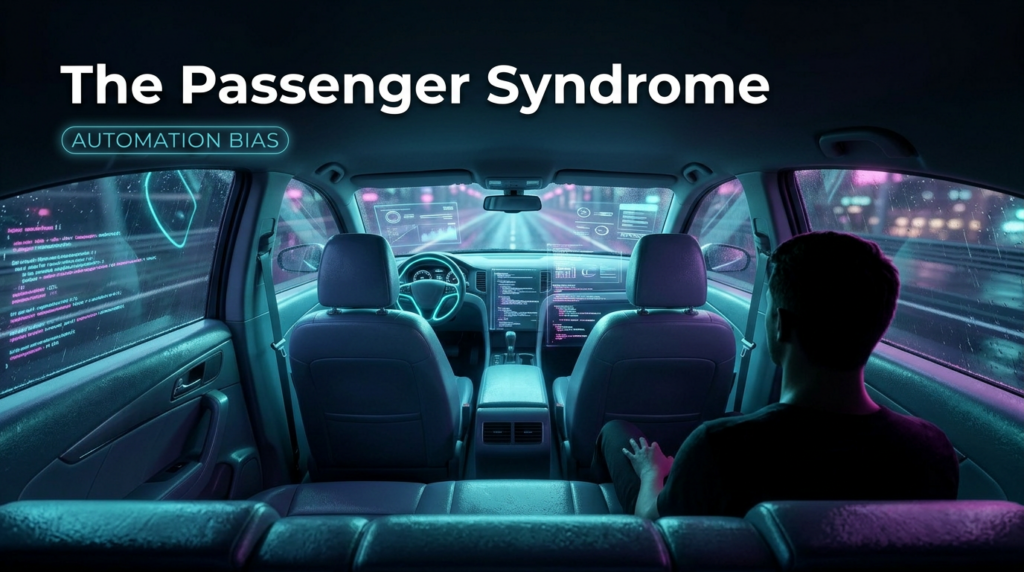
TL;DR: Generative AI is reshaping software engineering. However, the greatest threat isn’t job displacement—it is the subtle transition of developers from autonomous architects into passive operators. This article explores how “Automation Bias” and the loss of problem-solving satisfaction lead to skill degradation, cognitive atrophy, and professional demotivation, providing a strategic framework to reclaim control over your code and career.
The illusion of productivity and the pressure for velocity
The initial adoption of AI coding assistants (such as GitHub Copilot or Cursor) often feels like upgrading to a higher tier of automation. These tools excel at eliminating repetitive boilerplate code, generating unit tests, and accelerating initial prototyping.
However, business stakeholders quickly notice this surge in output. When management and Product Owners realize that code can be generated in seconds, performance benchmarks shift dramatically. Metrics like Velocity and Time-to-Market become the primary evaluation criteria for engineering teams.
This hyper-focus on volume and speed introduces critical long-term risks:
- Marginalization of Analytical Depth: Time allocated for domain understanding, architectural design, and edge-case evaluation is increasingly viewed as an inefficiency.
- A New Class of Technical Debt: Code generated rapidly under pressure creates systems that function superficially but suffer from architectural fragility, accumulating debt that teams must eventually pay back with interest.
Anatomy of the passenger syndrome
The transition from an autonomous engineer to a passive operator doesn’t happen overnight. It is a subtle cognitive shift—one that psychologists call Automation Bias.
In simple terms, when humans rely too heavily on automated systems under constant pressure for speed, three things happen:
- Loss of Situational Awareness (Loss of Mental Map): Traditional software engineering requires building a mental model of the codebase in working memory. When code is generated via prompts, this cognitive mapping is bypassed. The system quickly becomes an opaque “black box.”
- Skill Degradation (Bypassing The Struggle): Analytical thinking and problem-solving skills develop exclusively through the active effort of wrestling with complex problems. Eliminating this stage creates an illusion of competence—the false belief that one understands a system simply because generated code passes unit tests.
- Passive Debugging: When production failures occur, a passive operator no longer forms hypotheses or inspects system logs. Instead, they copy error messages back into the chat window, turning debugging into a trial-and-error loop executed by an LLM.
The erosion of craftsmanship, passion, and employee value
Behind the technical implications lies a deeper human crisis: the loss of intrinsic motivation and passion for the craft.
For decades, what attracted the sharpest minds to software engineering was not the physical act of typing syntax, but the intellectual satisfaction of problem-solving. The “Eureka moment”—resolving an intricate bug or designing an elegant architecture after hours of intense analysis—served as the primary source of professional fulfillment and dopamine.
Replacing this cognitive struggle with instant AI generation triggers a dangerous psychological chain reaction:
- Erosion of Purpose: Developers are deprived of agency and genuine accomplishment. Engineering degrades from a creative craft into assembly-line supervision.
- Growing Frustration and Demotivation: Spending the workday reviewing, tweaking, and fixing hallucinated or out-of-context code leads to disengagement and emotional exhaustion.
- The Cycle of Employee Degradation: A demotivated, frustrated engineer gradually lowers their standards. Pull requests are approved without rigorous scrutiny, and the drive for continuous learning vanishes. Consequently, the engineer becomes less valuable to the organization and easily replaceable.
Comparison: the autonomous engineer vs. the passive operator
| Dimension | Autonomous Architect | Passive AI Operator |
|---|---|---|
| Core Value | Problem deconstruction & system design | Applying generated code snippets |
| Primary Motivation | Solving complex engineering challenges | Rapidly closing Jira tickets |
| System Understanding | Complete grasp of architecture & constraints | Superficial overview of the codebase |
| Response to Errors | Root-cause analysis & hypothesis testing | Pasting stack traces into prompts |
| Cognitive State | Active engagement, skill growth | Automation bias, skill atrophy, frustration |
Strategic framework: reclaiming architectural mastery
To preserve your analytical edge, passion, and long-term value as a software engineer, you must implement deliberate boundaries around AI usage:
1. Design from first principles (paper first)
Before opening your IDE or writing a prompt, step away from the keyboard. Map out the domain model, data flow, edge cases, and architectural constraints on paper or a whiteboard. Define what needs to be built before asking AI how to write it.
2. Conduct unforgiving code reviews
Treat AI-generated code with healthy skepticism, exactly as you would code written by an intern who lacks system context. Inspect it rigorously for security vulnerabilities, edge-case failures, and architectural drift.
3. Maintain a “code gym”
To prevent skill atrophy and rediscover the joy of building, dedicate regular time to coding entirely without AI assistants. Solve algorithmic challenges, build personal side projects from scratch, or read framework source code directly.
4. Communicate architectural risk to business stakeholders
Mature engineering involves setting boundaries with management. Educate stakeholders on the fact that inflating line-of-code velocity without architectural oversight accumulates massive technical debt and destabilizes the product.
Conclusion
Generative AI is a powerful multiplier, but it must remain an execution tool, not a substitute for human thought.
The loss of problem-solving satisfaction and passion is a warning sign that we are surrendering the core of our profession. The ultimate value of a software engineer will never be measured by how quickly they can generate syntax, but by how deeply they understand the problems they solve and how responsibly they architect systems for the future.
Let’s talk
Does this sound familiar? If you’re a developer who feels the distance growing between the code you ship and the code you understand, or a lead who wants to keep a team out of passenger mode, write to me. I’m glad to help where I can, and it’s good experience for me as well.

