
Time Reclaimed in the AI SDLC? It Was Reinvested
Part 3 of a series. In How AI Is Changing the Way We Approach Code I argued AI takes the typing, not the job. In Vibe Coding Was the Warm-Up I showed the workflow that replaces prompting. This one is about the bill for that workflow, and what it turns you into.
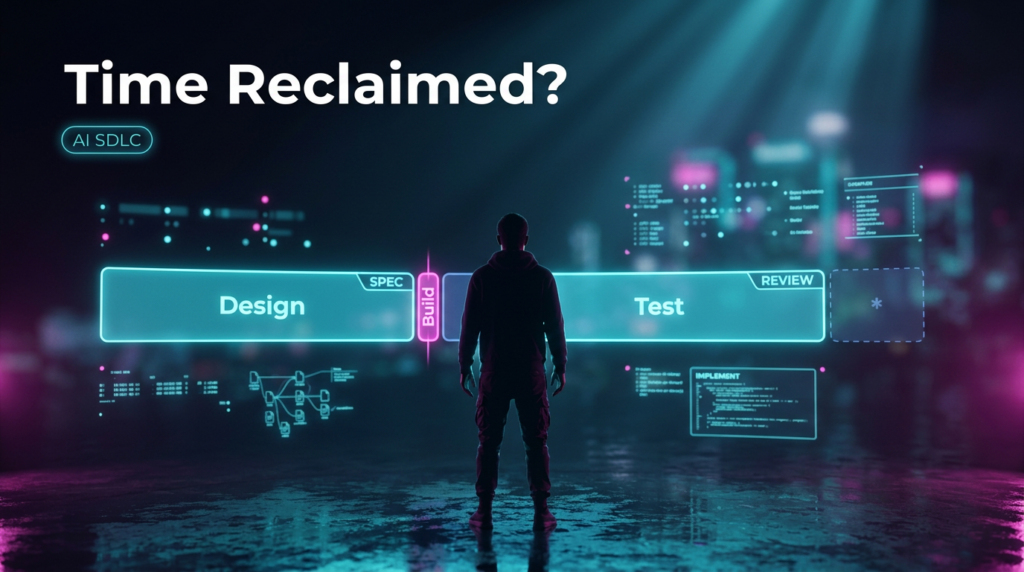
You know the slide from AI pitches: the SDLC with Build collapsed to a sliver and the freed space labeled “time reclaimed.” Build did shrink, nobody argues with that. But in my work the time didn’t come back. It was reinvested: upstream into specs, downstream into review. The scarce skill is less about writing code and more about knowing what code is worth writing, which is closer to an architect’s job than a typist’s.
The slide on Anthropic SDLC Playbook has six lifecycle stages (Plan, Design, Build, Test, Deploy, Maintain), and after agents arrive, only Build collapses. Everything else stands untouched, and to the right sits a happy empty rectangle: cycle time reclaimed. Free productivity, courtesy of magic AI.
I stare at that empty rectangle and think: mine isn’t empty. I know exactly what lives in it.
What actually happens before the agent types
The build itself? Dramatically faster, no argument. In part 1 I told the mailmock story: a side project I’d built over the years and left cold, which got spam scoring, spoofing checks and a ClamAV virus scan in under a day.
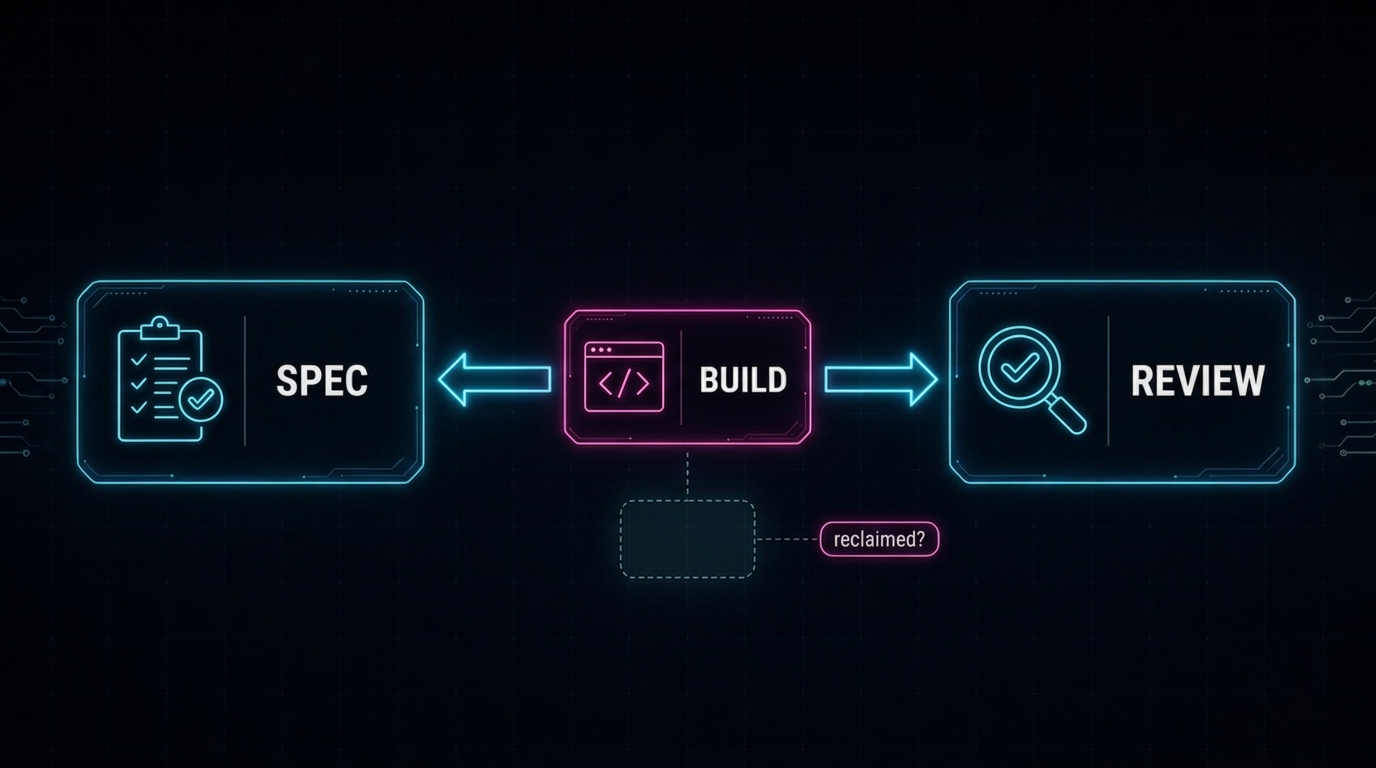
But before the agent writes a single line, I write. The spec and the context: acceptance criteria, package structure, which patterns, what NOT to do, how the edge cases behave. None of that used to be writing. It used to be a process that ran in my head, in stages, plenty of it off the clock. I’d sit down to code once it had already resolved itself.
An agent reconstructs part of that on its own. Plan mode digs through the code, asks a question or two, drafts an approach. But the questions stay shallow in my sessions, and whatever’s left unasked, it guesses, convincingly, and usually in the wrong direction. Most of what used to happen quietly still has to be forced onto the page first, because the agent’s reconstruction stops at what’s visible in the code, not at what’s still only in my head.
That day is the headline, and it’s true. It’s also exactly what the slide is made of. What the headline leaves out is the plan I wrote first and the review that came after: one caught a bug before a line of code existed, the other caught a security regression only once the feature was done, where turning on a real virus scanner would have quietly made a risky file look safe. None of that is typing.
Some of it carries over: my agent guidelines, lessons from earlier projects and reusable workflows move from project to project, and the plans of ten changes in two days shared one skeleton. It saves less than I hoped. The business and the architecture differ in every application and have to be described again.
My Design phase didn’t shrink. It grew. It just changed form, from a whiteboard and a conversation into a markdown file precise enough to leave the machine no room to guess.
What the research does and doesn’t say
I can’t prove with a stopwatch that the hours moved, and the research I know of can’t either. What it does show is that nobody feels where their hours go. METR’s 2025 randomized trial found experienced open-source developers took 19% longer with AI, while expecting a 24% speedup and still believing they’d gained 20% afterwards. METR now marks that result as out of date, and its 2026 follow-up is inconclusive: the raw estimates lean toward a speedup, but the confidence intervals include zero, and METR itself calls the data an unreliable signal, because developers who don’t want to work without AI dropped out of the study. So I take one lesson from both rounds: self-reported speed is a bad instrument.
DORA 2025 adds the downstream half. DORA’s own summary: AI is an amplifier, it magnifies whatever a team already has, good practices and weaknesses alike. In a survey of nearly 5,000 technology professionals, AI adoption now goes with higher delivery throughput (unlike a year earlier), and still goes with lower delivery stability, throughput and stability both amplified, one up and one down. DORA reads it as the acceleration exposing weaknesses downstream, unless you have strong automated testing, mature version control and fast feedback loops. Review is where I feel that pressure first, but that part is my inference, not DORA’s. My reading: the hours don’t vanish off the slide, they move to where the slide doesn’t look.
The vendors’ own tools point the other way
Here’s the part I like. The same industry that sells the “time reclaimed” story also ships a whole tool category built around the work that supposedly disappeared, the spec-driven tooling I already covered in Vibe Coding Was the Warm-Up, GitHub’s Spec Kit, Kiro and the rest. Sean Grove of OpenAI made the same argument at AI Engineer 2025: the valuable skill is communicating intent with precision. And Anthropic’s own playbook, the one behind the slide I opened with, tells teams to start from an intent.md, turn it into a spec and a plan, and put a human review between each stage. Its own caption already says the constraint moved to the human-speed steps around Build.
But notice the contradiction: the pitch says the time is reclaimed; the products are built to spend it on specs. I trust the products.
One more cost the slide never shows: messy code is a tax on whichever agent reads it next, mine or someone else’s, and I already wrote about managing that budget in Context is Money. The short version: clean architecture was always an investment in the future reader of your code. The future reader just started charging per token.
So, more architects than developers?
Put it together. Build increasingly belongs to the agent, and the value concentrates in the spec, the architecture and the review. The skills that matter are: describing what and why precisely enough that a machine can own how; knowing what maintainable code looks like; catching a wrong turn early enough that fixing it means rewriting a paragraph, not a codebase.
| Yesterday’s scarce skill | Today’s scarce skill |
|---|---|
| Translating intent into syntax | Making intent precise enough to delegate |
| Knowing the framework | Knowing the boundaries |
| Writing fast | Deciding well |
And that list reads a lot less like a developer’s job description than like an architect’s.
One honest caveat before the closing line: architects aren’t printed in bootcamps. They grow out of people who broke production code themselves and remember how it felt. If agents take that breakage away from juniors, where does the next generation of spec-writers come from? I don’t have a clean answer, but I’d rather ask it now than after the pipeline runs dry.
So no, the time wasn’t reclaimed. A good part of it was reinvested: in specs, in review, in architecture. And in you. I didn’t stop programming when I started working with agents. The agent became my builder. I became the architect. The promotion just never got announced at standup.
Let’s talk
Does this match what you’re seeing? The build is fast, but the thinking moved upstream, and nobody resized the team’s skills for it. If that sounds familiar, write to me. I’m glad to help where I can, and it’s good experience for me as well.
Links & tools
- METR, developer productivity RCT (2025), marked out of date by METR: https://metr.org/blog/2025-07-10-early-2025-ai-experienced-os-dev-study/
- Anthropic, “The AI-Native SDLC Playbook”: https://claude.com/blog/the-ai-native-sdlc-playbook
- METR, 2026 follow-up and experiment redesign: https://metr.org/blog/2026-02-24-uplift-update/
- DORA 2025, State of AI-assisted Software Development: https://dora.dev/research/2025/dora-report/
- Google Cloud, announcement of the 2025 DORA Report: https://cloud.google.com/blog/products/ai-machine-learning/announcing-the-2025-dora-report
- Sean Grove, “The New Code” (AI Engineer 2025): https://www.youtube.com/watch?v=8rABwKRsec4
- GitHub Spec Kit: https://github.com/github/spec-kit
- AWS Kiro: https://kiro.dev
- mailmock, the example above: https://mailmock.app